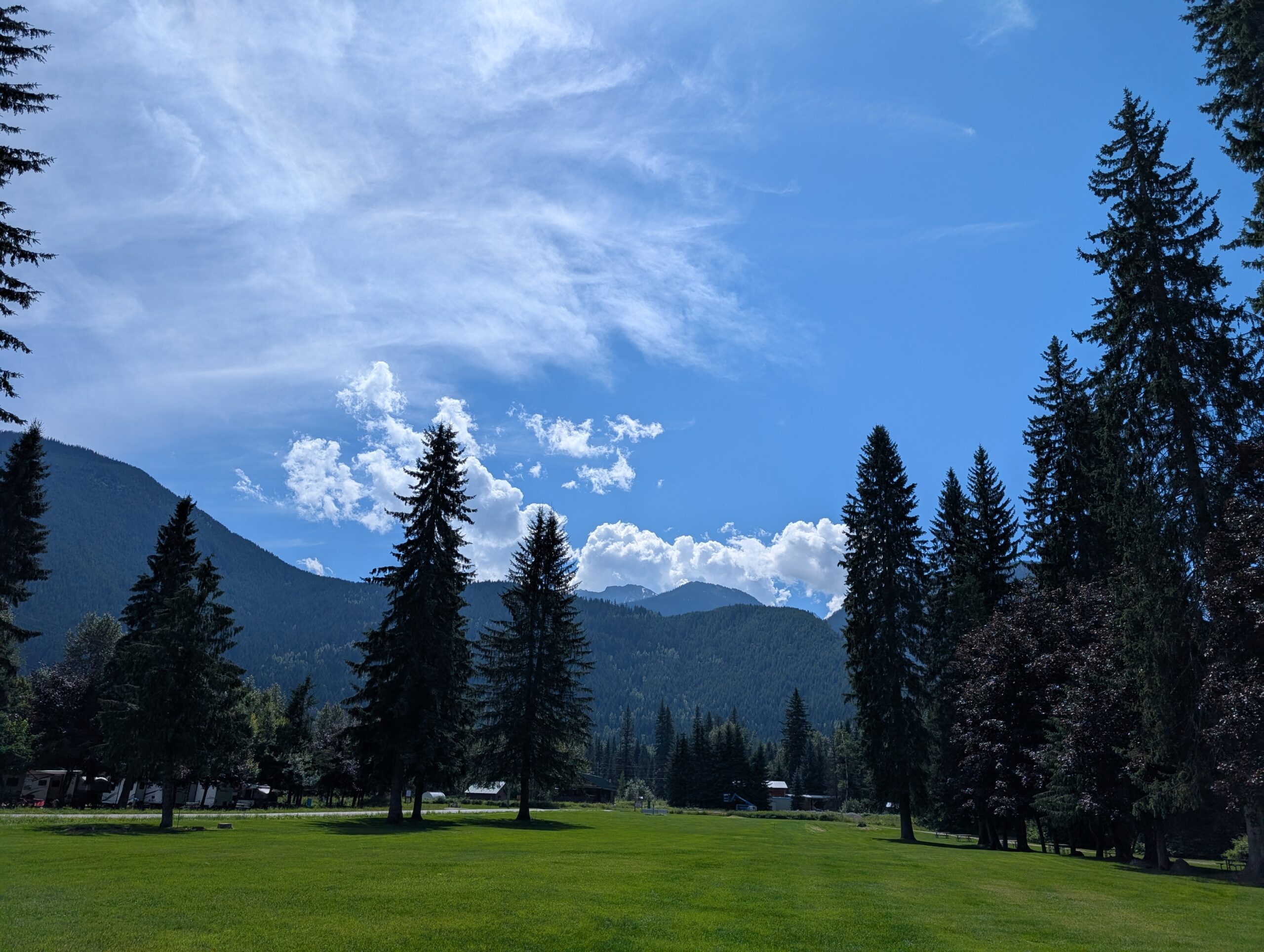
Beautiful BC – a slogan for this province for decades. It is a fitting slogan, because the province is indeed beautiful. Stunningly so. It’s an overwhelming visual experience, quite frankly. There is no pause to blink and relax; it’s one visual sensation after another. Exhausting, positively exhausting. Gloriously exhausting.
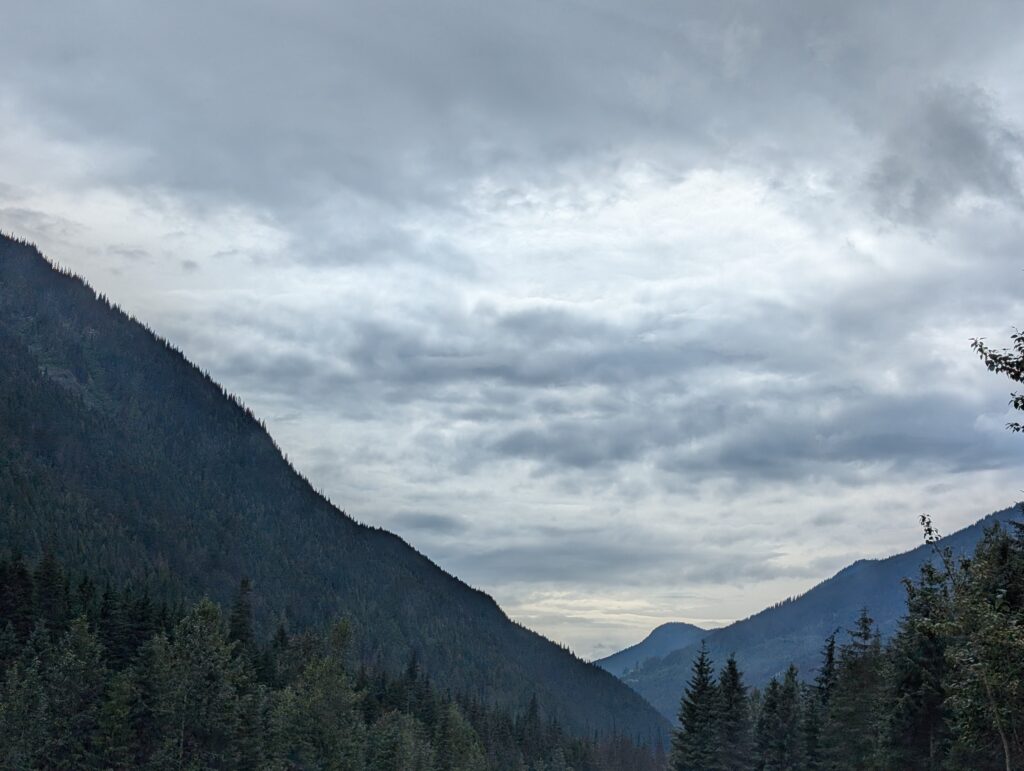
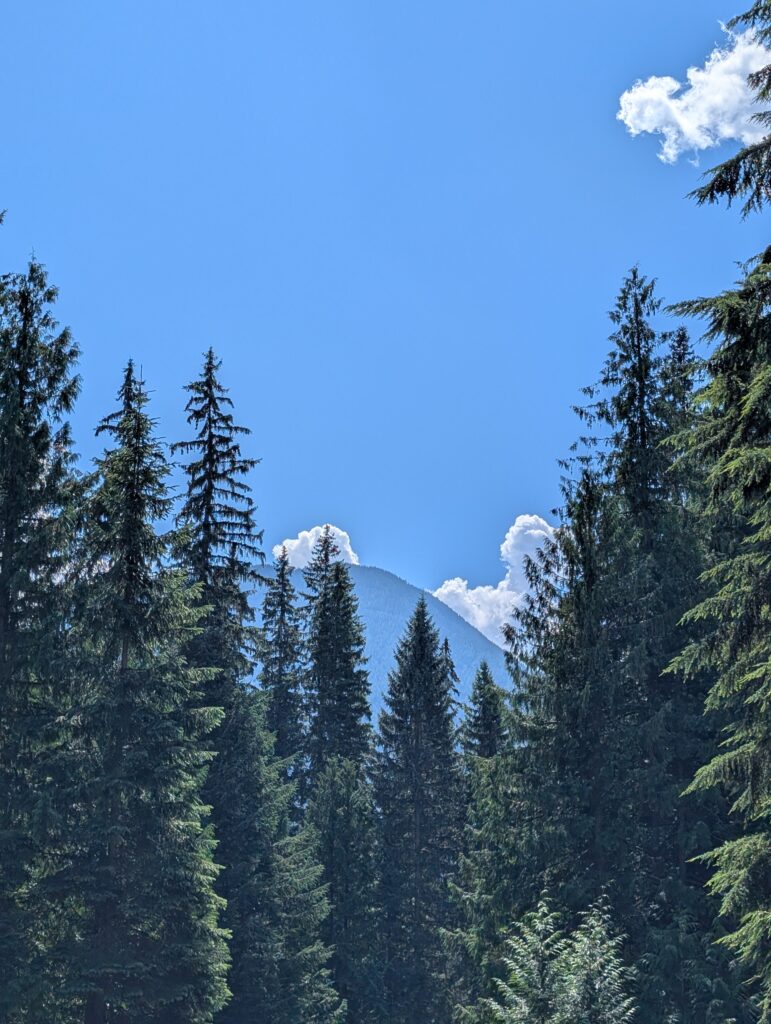
We camped for a couple of nights at Canyon Hot Springs Resort, a commercial campground in Albert Canyon, in the midst of the Selkirk Mountains. The taller of these mountains, seen from the campground, is possibly Mount Albert, from which the canyon takes its name. These mountaintops, older than the Rockies, filled every direction, looking imposingly graceful, as mountains do. It was a prelude of the scenery that was to continue through British Columbia.

You will recall that the long, silvery ribbons of the railway tracks tie Canada into a cohesive whole. During our travels, we noticed how the railway provides a crucial link across Canada. Tracks crisscross our country, providing a thousands-of-kilometres-long pattern for commerce and industry. A double-track skirted the edge of our campground; what a location to drive a train.
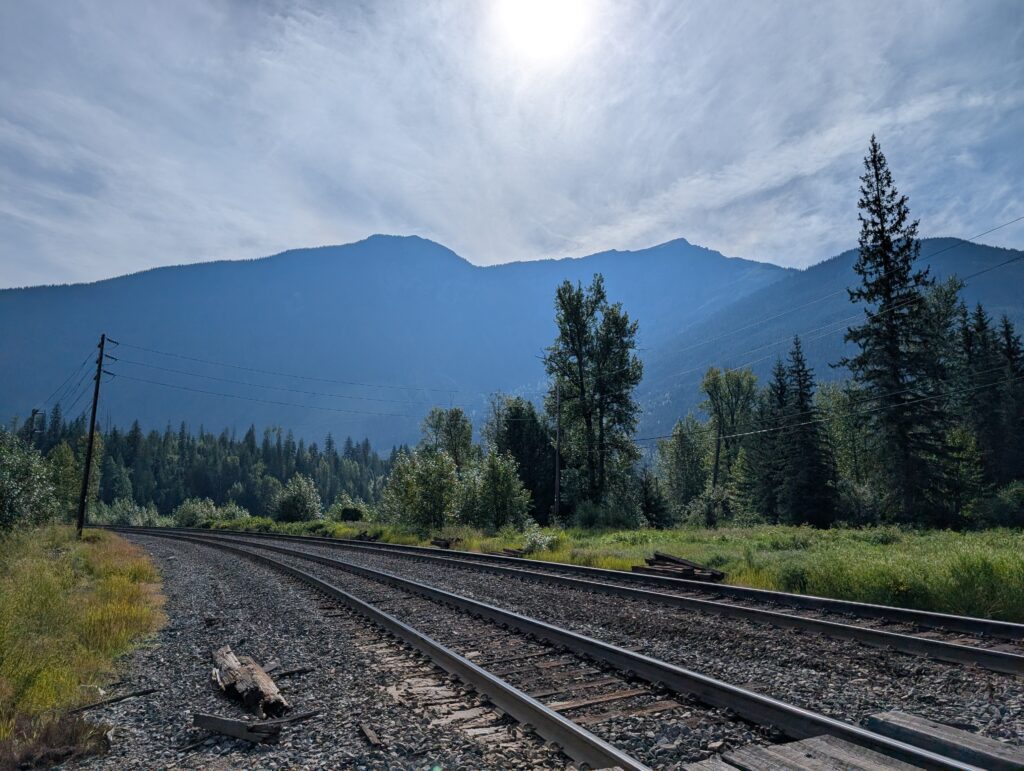
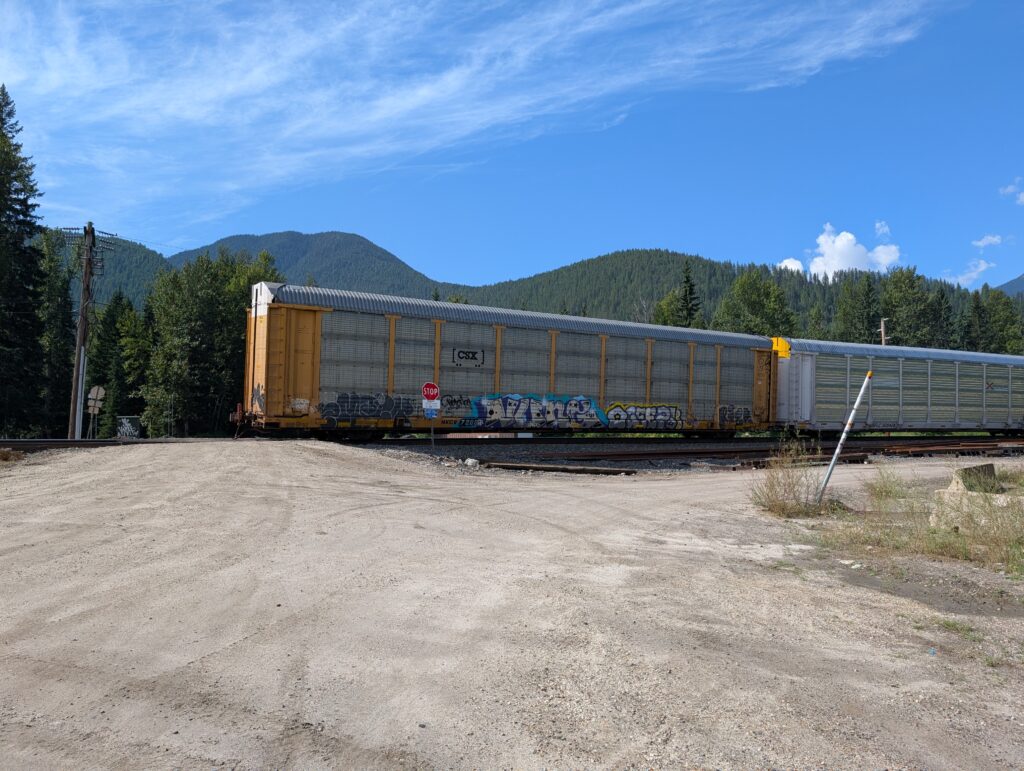
We heard trains all day and all night. It was sounds from my childhood, when we lived near the tracks. We went down to the level crossing at the end of the campground to watch trains, as one does.

It’s quite easy to sit for an hour or more, waiting for trains. It was almost edge-of-the-seat exciting because there were up to ten trains an hour, and some of them were very long. I’ve lost my knack for counting cars. Unfortunately the cabooses seem to have disappeared so the pleasure of waving to the caboose attendant has been erased from train watching.
Decades ago this location, Albert Canyon, was a designated train stop, a pause before the climb to Kicking Horse Pass. The rapidly flowing Albert Creek, is spanned by a basic train bridge, which is essentially some long railway ties propping up the railway track, and held in place with steel girders. A narrow vehicle bridge adjacent to the tracks gave us allowance to cross the river safely.

Safety is relative. The vehicle bridge gave the impression of being rickety, made out of some cross beams with a metal mesh on top, and barricades about as high as a street curb. In fact, it was very secure and level. Not a wobble. Not a wiggle. The mesh was a tad slippery, which required careful stepping.
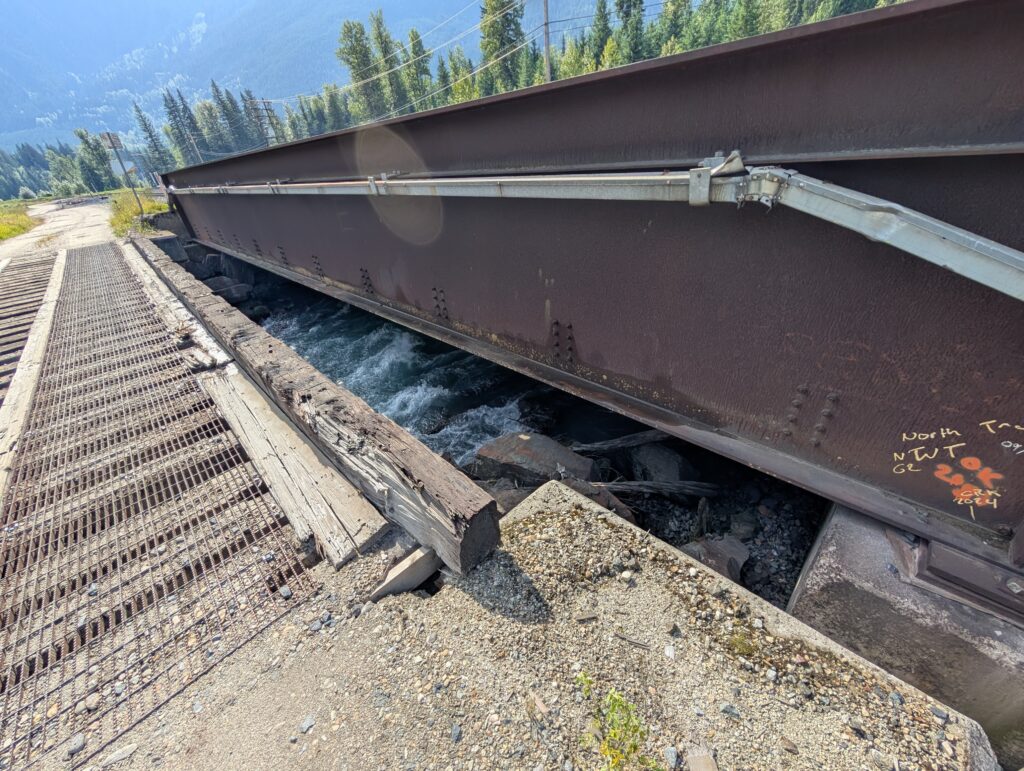
I walked carefully because that raging water rushed headlong under the bridges, centimetres from my feet, en route to its junction with the Illecillewaet River. Raging, of course, because it drops from about 1700 metres height to 700 metres height, a difference of 1 kilometre, in just over 3 kilometres. A 33% gradient! I’d be raging too if I tumbled that distance.
I didn’t dare look down when I walked across the bridge. My eyes were on the horizon. Vertigo on a barracade-less bridge is not ever a desired experience.
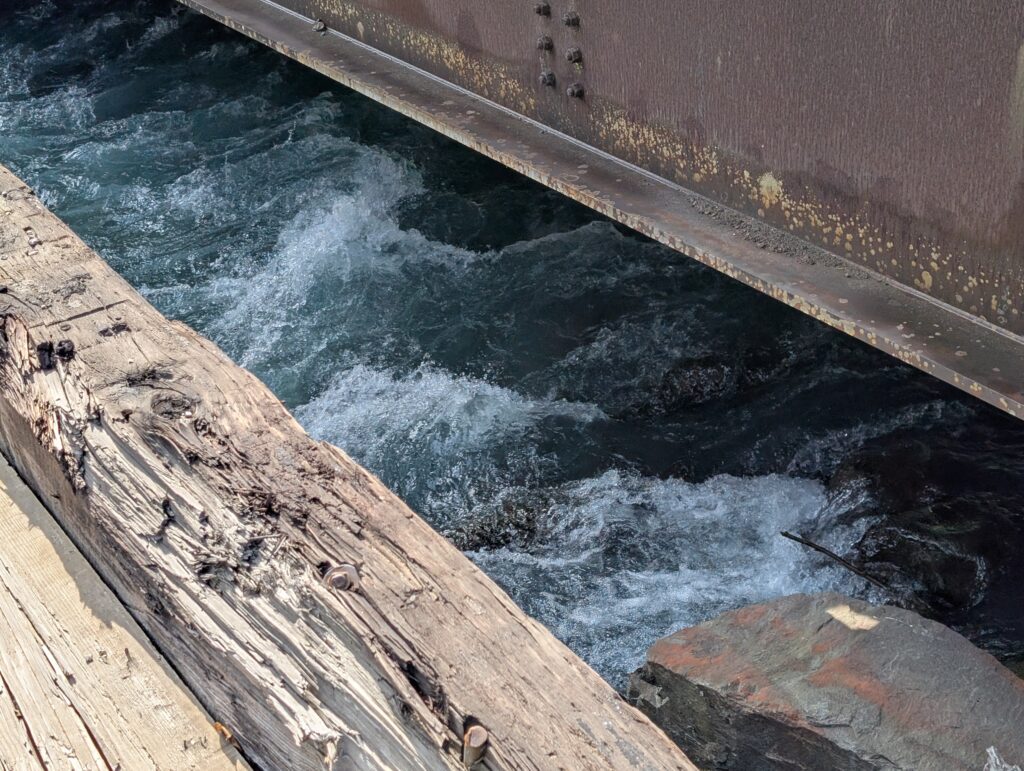
The water speeding along close to the banks emphasised that the drop in elevation continued beyond this portion of the Albert Canyon. Granville, who likes to splash in water, had to be restrained. Once she stepped up to her knees into the glacier-fed water she seemed to realise there was sense in exercising caution around this fast-flowing, very cold creek.

This wide spot in Albert Canyon is an oasis in the midst of rough, near vertical igneous and metamorphic mountains. As befits an oasis, the campground had a lush forest on one side.

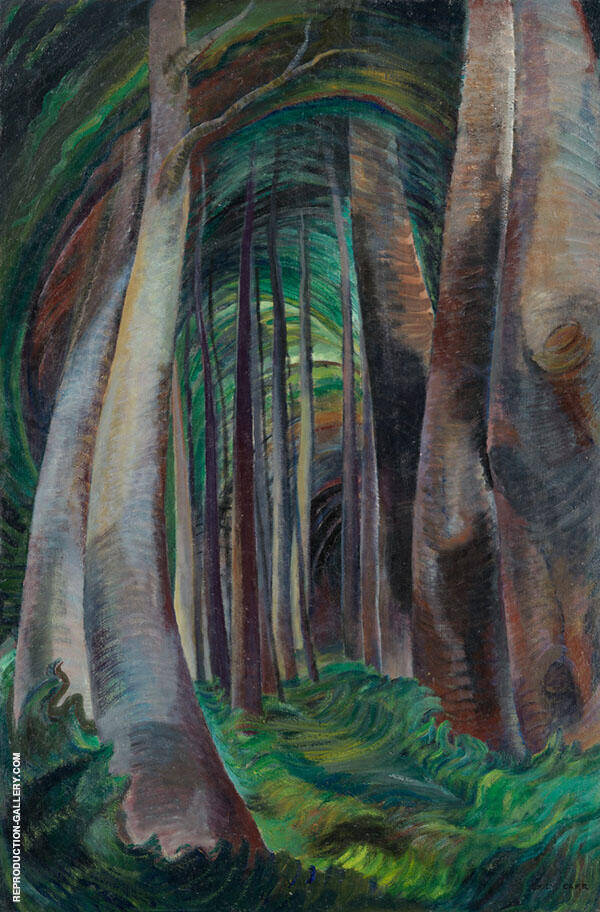
As we walked along the groomed path, all I could think about was Emily Carr, the British Columbia artist, contemporary of the Group of Seven, who painted Northwest Coast scenes. I know she did not paint in this part of British Columbia, but the woods here mirror the woods on the coast. Wood Interior (1932) is an example of one of her famous paintings that could have been painted in this place.
We came to the banks of Albert Creek from a different angle. The water was dull turquoise, still showing its glacial origins, still moving quickly, and still mesmerising to watch.
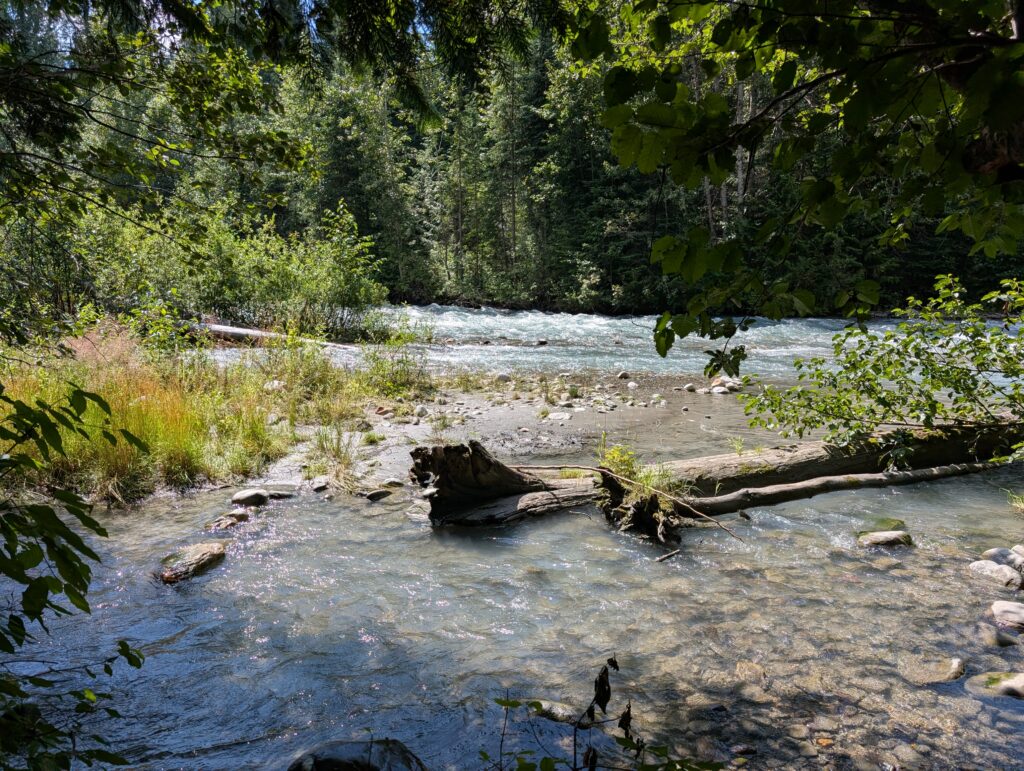
And we still had to restrain Granville from leaping in for a paddle. That current would have swept her away, eventually taking her to the Columbia River and then to the Pacific Ocean. We preferred to take her with us in the camping trailer, but it was tempting…

For my part, I gazed up and up, craning my neck and leaning back a bit, drinking in the magnificence, absorbing it, admiring it, enjoying it, overwhelmed by it. The Canadian Cordillera, the western conglomerate of mountain ranges, plateaus, and valleys, is worthy of its wide-spread exaltation. The British Columbia mountains and their side-features, the secondary characteristics like these that lend depth and gloss to the mountains, are spectacular. They are a rich and satisfying illustration of the licence plate motto “Beautiful British Columbia”.
Leave a Reply