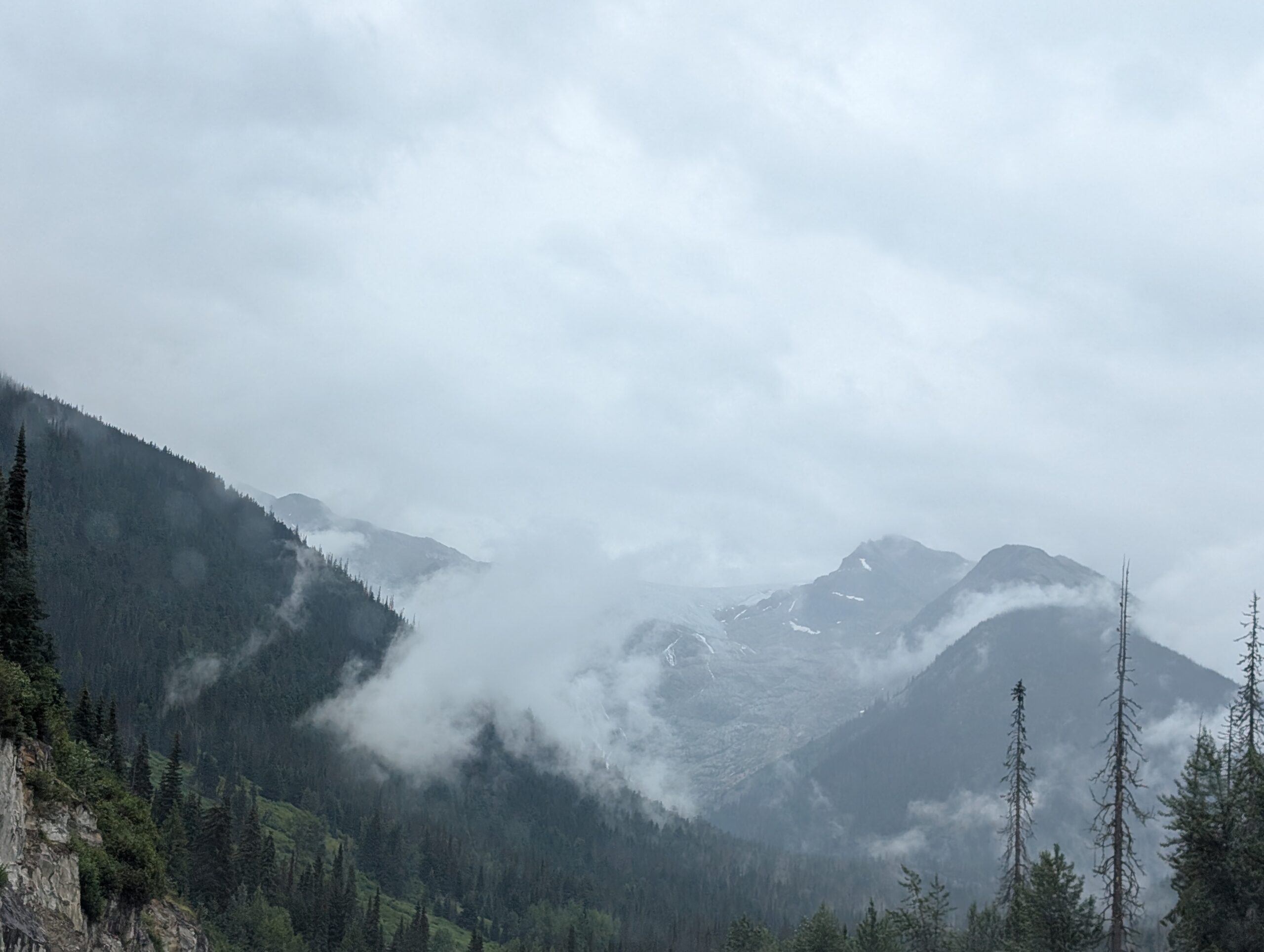
Kicking Horse Pass spans the border between Alberta and British Columbia. Scouted and surveyed by the Palliser Expedition in 1858-1859. At that time the Yellowhead Pass was used to travel over the Rocky Mountains. The objective of the expedition and survey was to explore and map western Canada, to find areas for settlement and to counter American expansion. They were also charged with finding a less arduous and shorter route between the, then, Northwest Territory and British Columbia. This pass was built in the 1880s, initially as a conduit for the Canadian Pacific Railway, and a link from British Columbia to Canada. Because of the promise of this link, British Columbia joined Confederation in 1871.
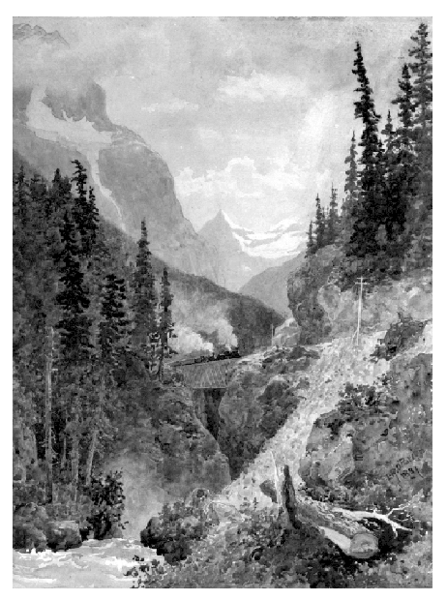
Title: Kicking Horse Pass, Author: O’Brien, Lucius Richard, 1832-1900 Credit: BC Archives #PDP04901 [1]
We chose this route, in part, because of the historic significance of Kicking Horse Pass. The steep canyon walls, and the close proximity of the mountains required a unique engineering feat – spiral tunnels. These are tunnels that swirl and follow contour lines, but inside the mountains, so the train drives into an arch at one elevation and appears some time later at an arch at another elevation, seeming to cross over itself. We see this technique used in road construction these days, although the dramatic effect of crossing over our own vehicle does not happen with cars.
https://parks.canada.ca/pn-np/bc/yoho/culture/kickinghorse/visit/spirale-spiral
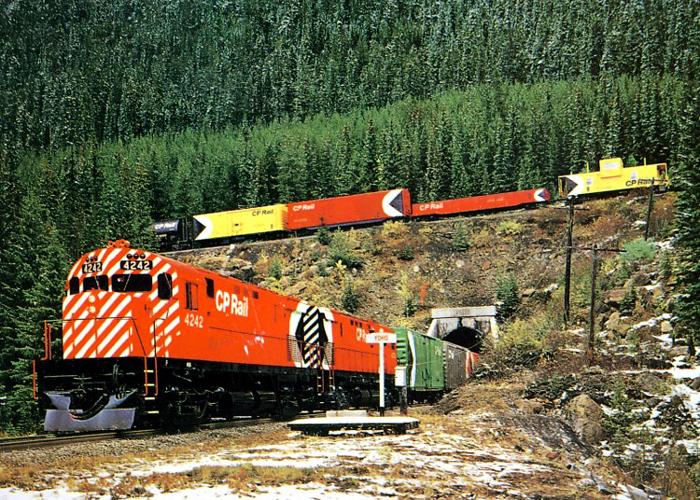
There is a Parks Canada Historic Site with places to pull off the road on this route. The Spiral Tunnel viewing site was jam packed with vehicles. It’s a popular sightseeing spot. The Spiral Tunnels were, and continue to be, a feat of engineering. The train tunnels were constructed over a couple of years, from 1907-1909. Typically, 25-30 trains move through the tunnels every day. That’s a lot of train traffic, indicating that for the past hundred years these spiral tunnels have been important for moving products east and west across the country. Much as these sights interest us, because it was raining and the place was crowded, we decided to make a specific trip to see the tunnels in action, so to speak, on a later date.

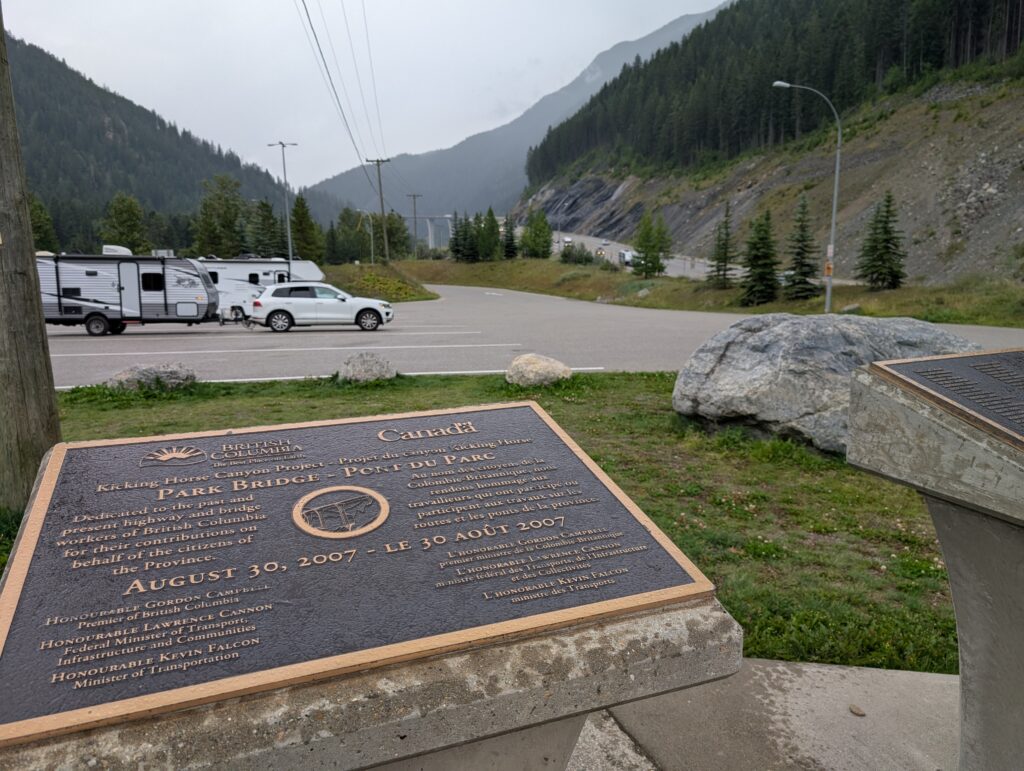
Just over the Kicking Horse Pass overpass, called Park Bridge, there is a combined Canada and British Columbia site. This is located approximately where a kicking horse incident happened, and for which the pass is named. Apparently some pack horses in the Palliser expedition had fallen into the river. A surveyor let his horse graze while he was helping retrieve the pack horses When he returned to his own horse, it kicked out, catching him in the chest. From then, reference was made to the Kicking Horse River. The pass was given the same name.
There is a very faded descriptive information board at the site. It leads the eye towards the high walls of the canyon, and the mountains surrounding the pass. More than a hundred and fifty years ago the terrain was the same, but transportation was more basic.
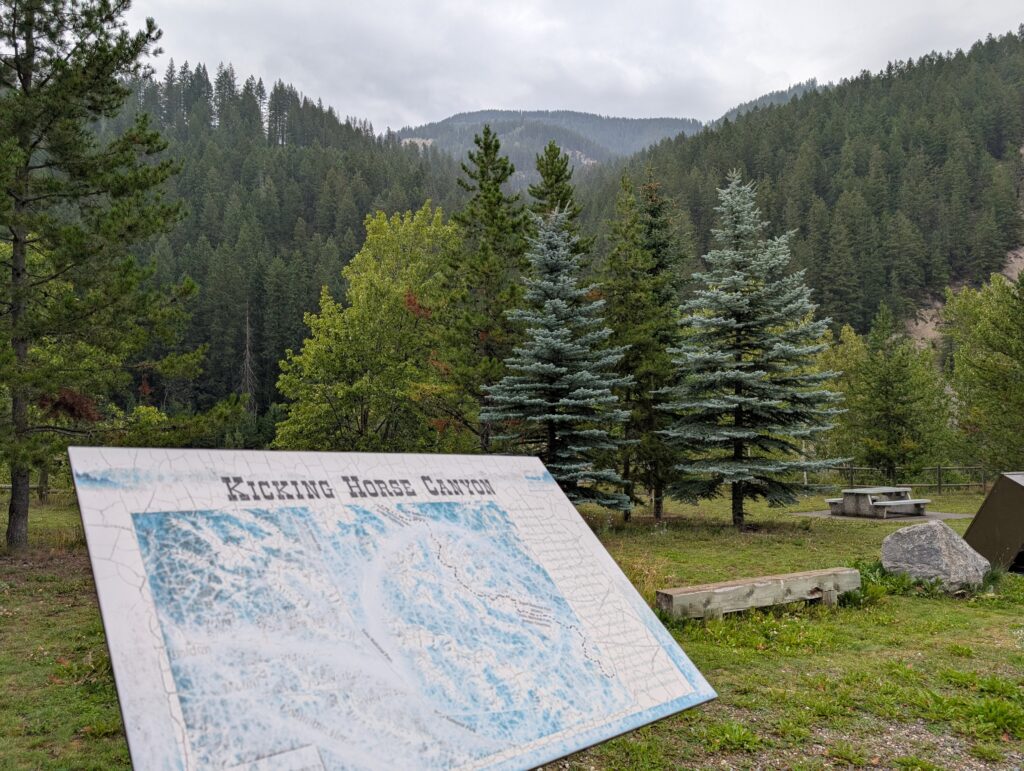
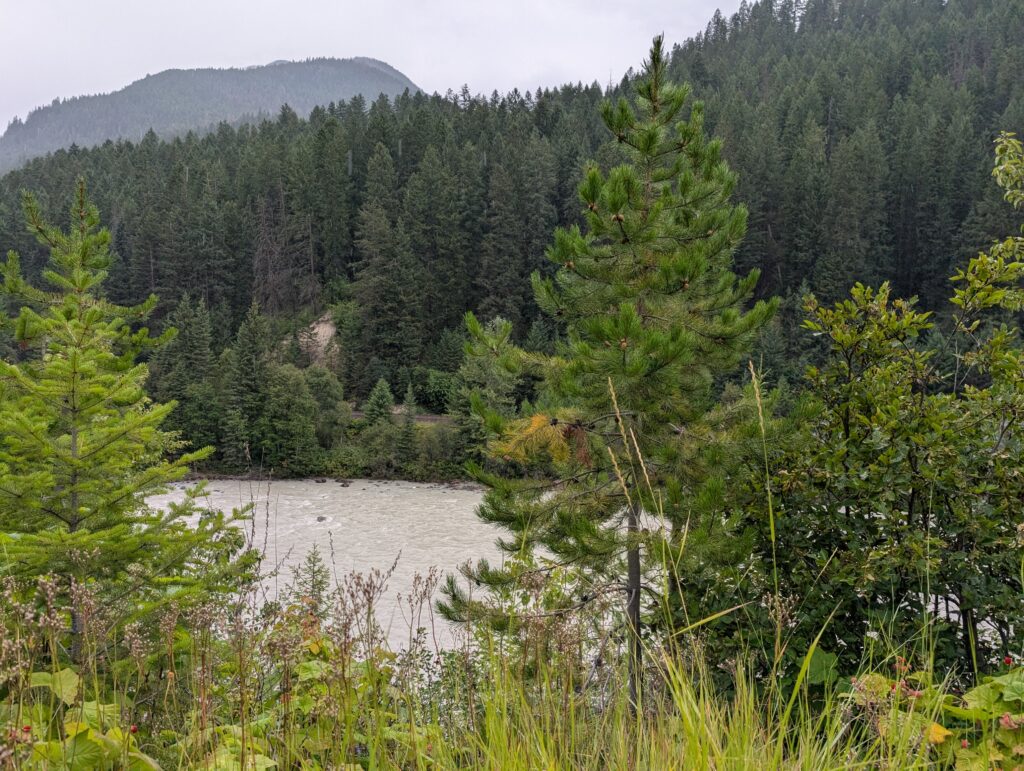
Despite the rain, we took Granville for a walk around the perimeter of the park. We needed to move around because all of us were getting stiff from sitting in the car for several hours. In this place, we were reminded about much we appreciated travelling around in a vehicle, sheltered from the rain, in relative comfort, and not worrying about ornery horses having a hizzy moment. That saunter took us to the banks of the Kicking Horse River, where we replayed in our imagination that event a century and a half ago when an annoyed horse gave the river its name.
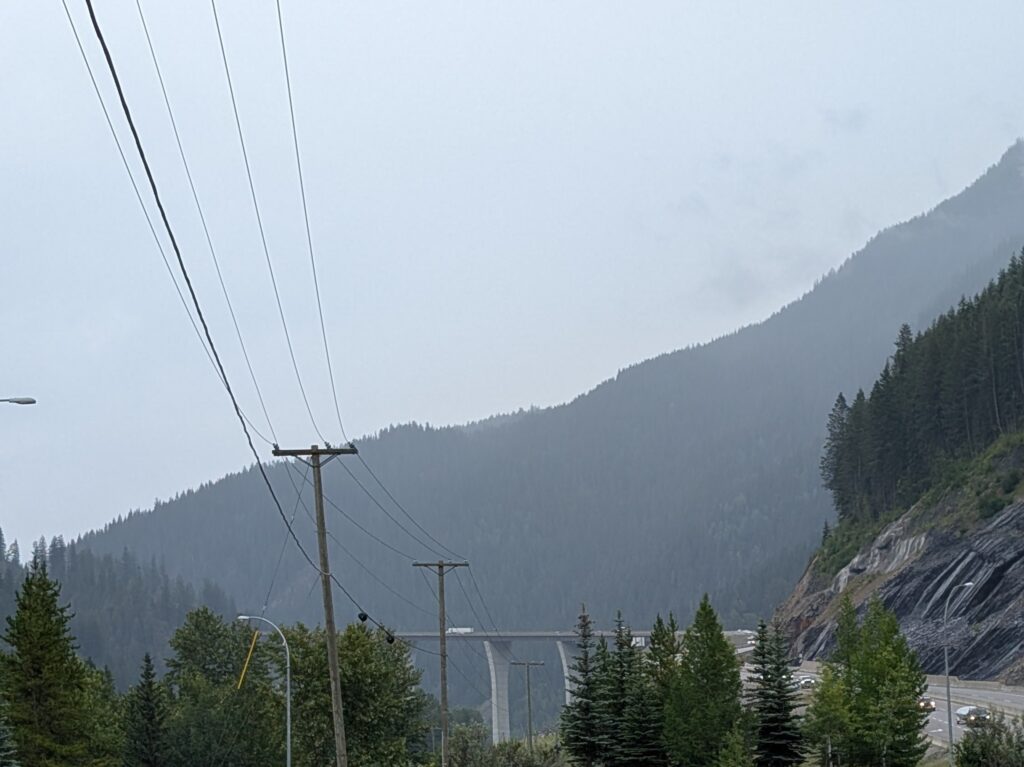
Standing in the rain, looking back up the Kicking Horse Canyon, we were gob-smacked at the height, and grace, of Park Bridge over which we had just travelled. In the distance it’s the 400 metre long colossus standing 90 metres upright and flamboyant over the canyon floor. Our vehicle and trailer in the parking lot, look minuscule in the midst of the gigantic grandeur of these Rocky Mountains.
A recitation of Ozymandias, the poem by Percy Bysshe Shelley, seemed in order. At some point in the future it could be the subject of a similarly themed poem. For now, we stood in admiration of the phenomenal structures that surveyors, engineers, and construction teams can build.
Building the railway through this rather inhospitable geography was an unrivalled engineering feat. It was mimicked with the construction of the Trans Canada, which basically, then and now, follows the railway route, except without the extended spiral tunnels.
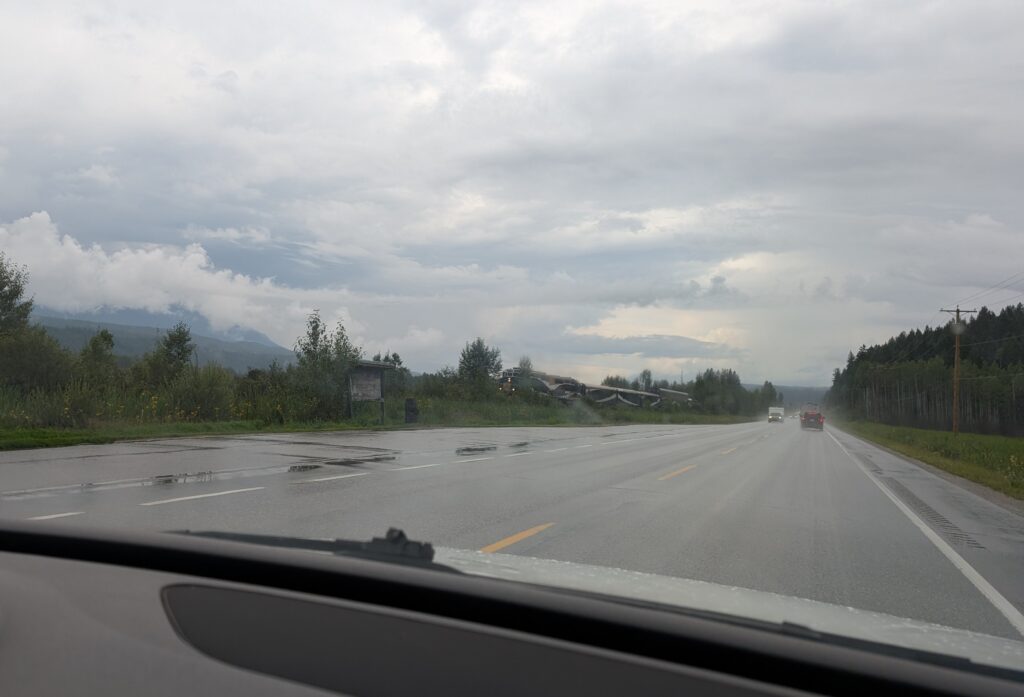
The road was narrow and steep, so a plan was made to widen Highway 1 from Kamloops to Banff. This has been a continuing project for many years. The engineering details and accomplishments are best explained by the experts:
https://www.tranbc.ca/2021/07/21/four-laning-bc-highway-1-your-questions-answered
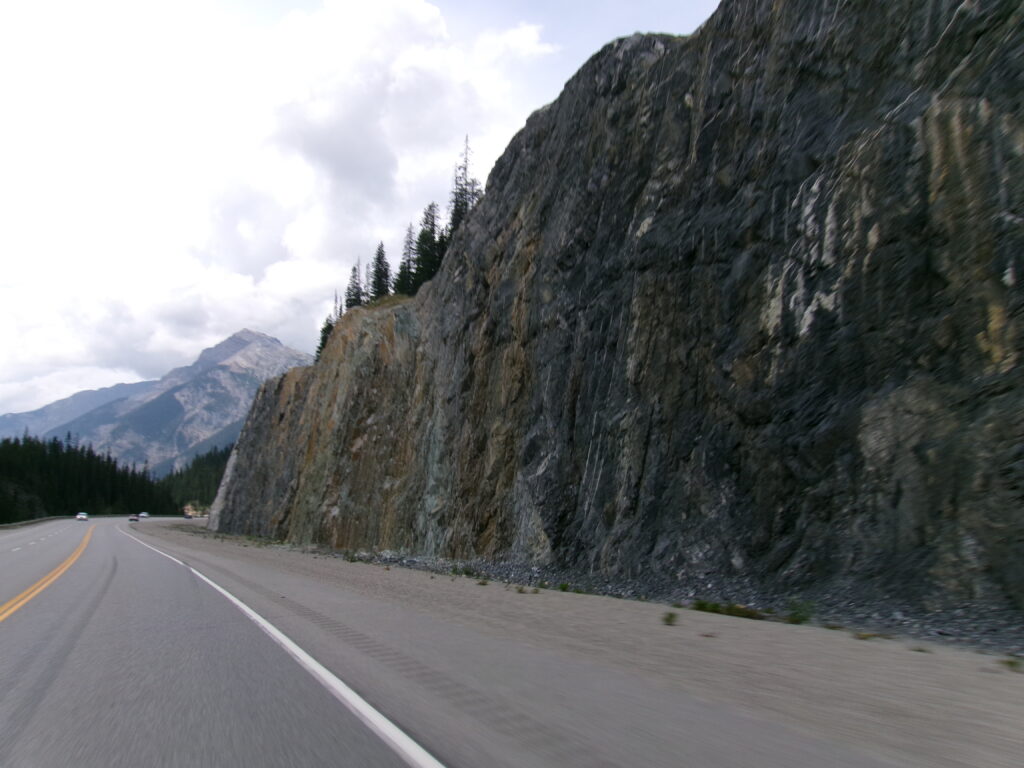
We were glad to cruise along the widened Trans Canada. There was evidence along the route of some of the solutions to the challenges of constructing this road to contemporary standards, including safety for humans and animals. First, of course, to smooth the route, the road had to be cut through the mountains. Some of the rock cuts were as tall as high-rise apartments.
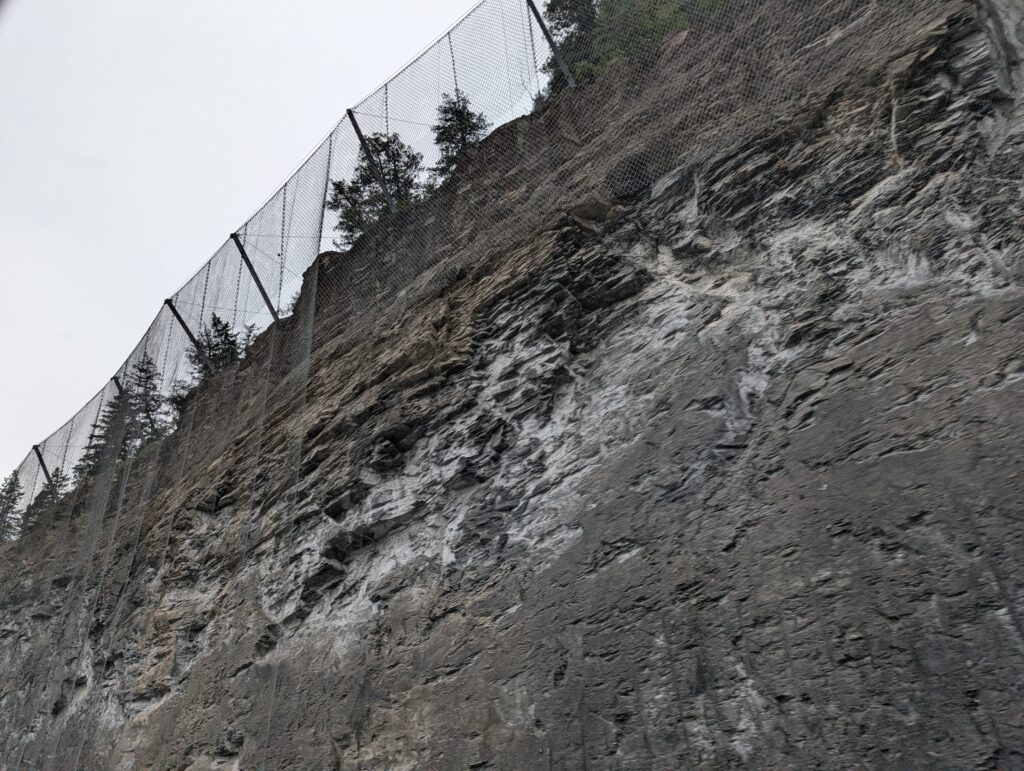
Fences were constructed at unusual angles to catch falling rocks, or leaping elk or mountain goats.
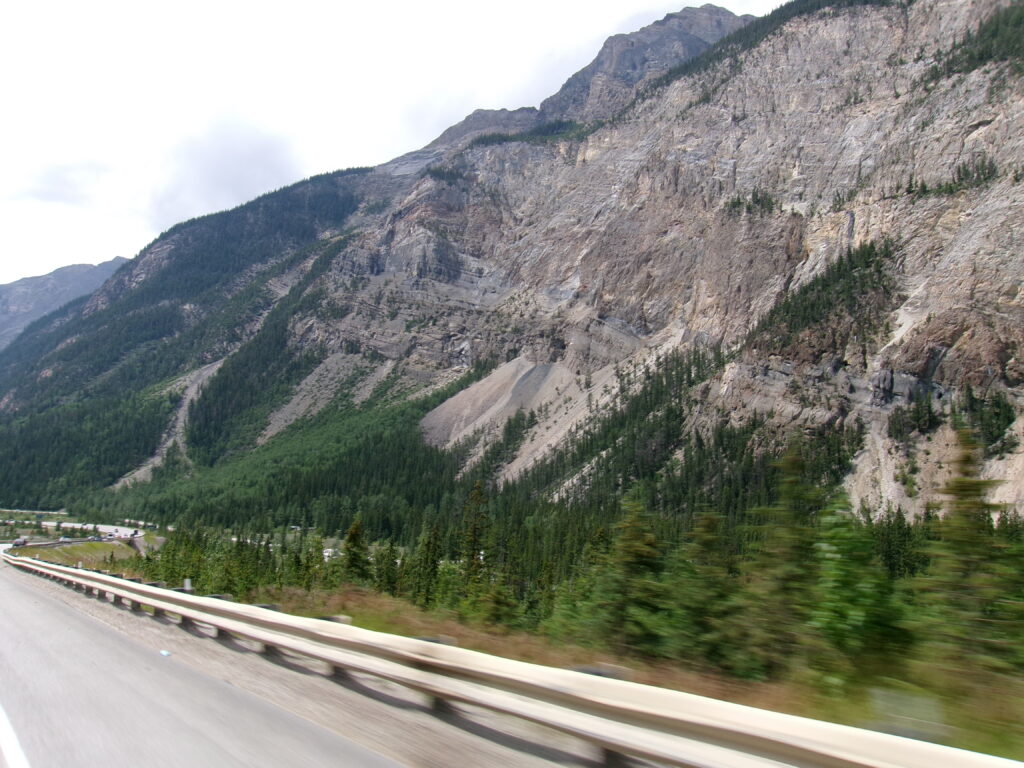
Delightfully wide ess-curves helped the drivers almost glide down the mountain slope. Gone are the days of roller-coaster highways, and the resultant nausea for many passengers.
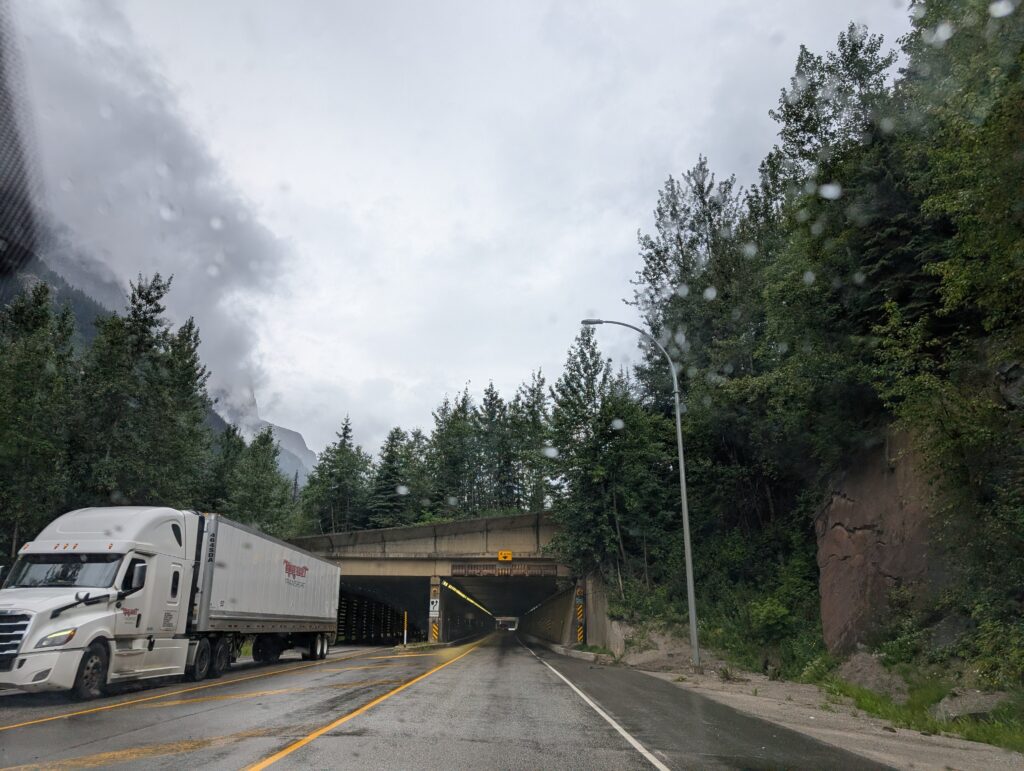
A series of snowsheds added visual variety along the route. Snow sheds are concrete tunnels that might curve a bit, but they do not spiral. Their main purpose is avalanche control. They cover the sections of highway prone to avalanches. By defraying the snow, they help keep the highway open during the winter. This is an important consideration in this snowy, mountainous region.
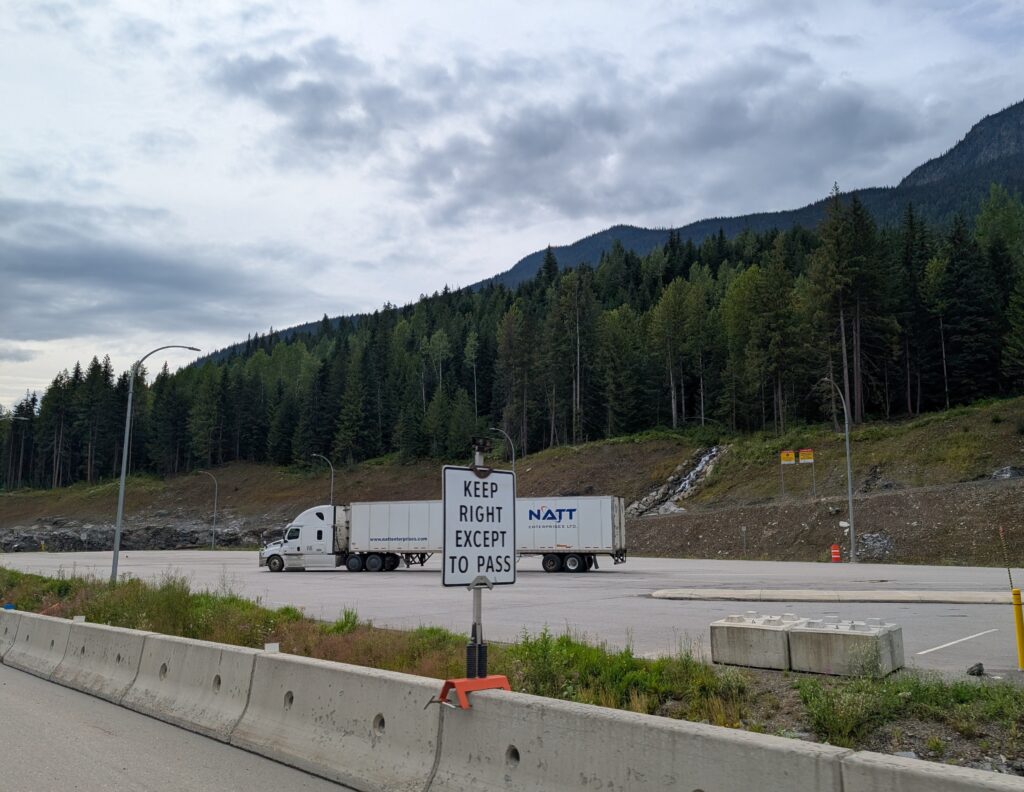
The slope, approximately 5%, extended for several kilometres before it levelled out. Many times a vehicle, especially a truck, could get going too fast, so efficient, effective brakes were required. Good drivers regularly check their brake and at regular intervals spaces were provided for that task.

Almost always there was a transport truck parked in the brake check area, just cooling the brakes before continuing down the incline. We were impressed at the obvious participation in this safety measure. Of course, drivers are safety conscious, and do not want to experience a run-away truck on these steep hills.
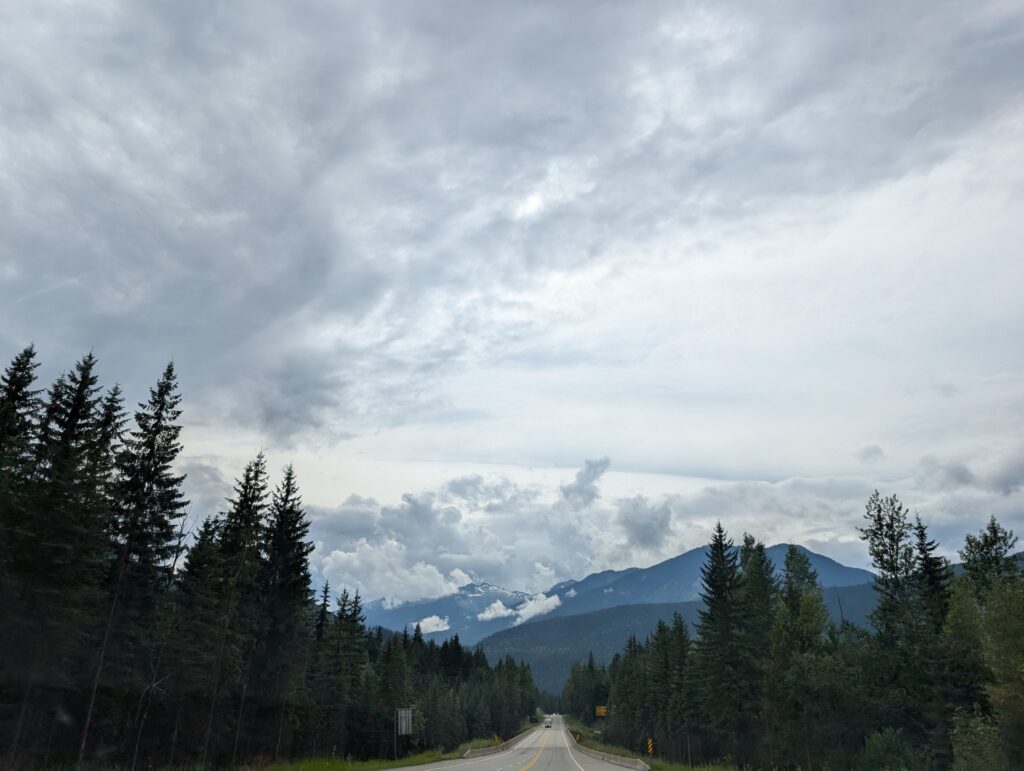
Our route was a fairly steady downhill drive after Kicking Horse Pass. We had followed an historic route as much as possible. The modern upgrades to the highway infrastructure did substantially modify the original route, making it a much more amenable drive. The dramatic mountain-scape was spectacular, as spectacular as it would have been a century and a half ago when Palliser’s expedition first explored the route through the Rocky Mountains. We were glad to have a contemporary road, and not have to hack our way through the wilderness like the early expeditions and surveyors did. Smooth roads is modernisation that we all appreciate.


Leave a Reply